
Monday, December 29, 2008

Sunday, December 28, 2008
Eternal Summer of the Black Feminist Mind!!!

Due to the huge and affirming response to BrokenBeautiful Press's Summer of Our Lorde we are THRILLED to present the Eternal Summer of the Black Feminist Mind, a portable progressive series based in Durham North Carolina in partnership with SpiritHouse, Southerners on New Ground, UBUNTU, the Land and Sustainability Working Group, Kindred Healing Justice Collective and more.
In 1977 the Combahee River Collective wrote a key black feminist manifesta groundbreaking in it’s assertion that the “major systems of oppression are interlocking. You are invited to the first session on the groundbreaking black feminist document The Combahee River Collective Statement. Download it at www.blackfeministmind.wordpress.com
and check out some radical exercises at www.combaheesurvival.wordpress.com
In Durham we'll be discussing it on January 7th. Email brokenbeautifulpress@gmail.com for details and feel free to read along wherever you are and comment here!
See you (t)here!!!!!
Thursday, December 18, 2008
Tuesday, December 09, 2008
SEWSA 2009
SEWSA '09
Southeastern Women's Studies Association Conference
at Appalachian State University, Boone, NC
Thursday - Saturday, April 2-4, 2009
WOMEN AND ENVIRONMENTS:
The Ecology of Feminism and the Feminism of Ecology
INFO & LINKS:
* Keynote speakers:
Elisabeth Lloyd
Chris Cuomo
Marilou Awiakta
Beverly Guy-Sheftall
* Workshop:
Starhawk
* Call for papers (doc)
* Lodging and transportation
* Registration info--registration is online only and requires a credit card
* Film series
* Food menus--gourmet all-natural lunches included for conference registrants
* Goat and cheese farm tour
$15/person to the first 25 people who sign up!
* Student scholarships
Topics might include:
*
Environmental racism
*
Development
*
Environmental policies
*
Frankenfoods
*
Naturalists
*
Localvores
*
CSAs
*
The Slow Food Movement
*
Pharmaceuticals
*
Ecofeminism
*
Eco-tourism
*
Women in pollution and waste management
*
The environment and women's health
*
Women's environmental activism
*
Gender and food history
*
Environmental toxins
*
The politics of space and place
*
Darwinism
*
Farm Workers
*
Women in environmental history
*
The female in nature
*
Women and animals
*
Green businesses
*
Ecological communities
*
Ecofeminist literary criticism
*
Feminist literary ecology
*
Women healers
*
Women naturalists and conservationists
*
Science, technology, and the environment
*
Post-humanism
*
Feminist vegetarianism and feminist hunting
*
Situated knowledges
*
Is feminism green?
*
Are women green?
IMPORTANT DEADLINES:
*
PROPOSAL DEADLINE EXTENDED TO JAN. 15, 2009!: Send to womens_st@appstate.edu with all contact information.
*
Feb. 1, 2009: All those with accepted proposals will be notified by this date.
*
Feb 15, 2009: Deadline for "earlybird" registration.
*
March 12, 2009: Deadline to reserve a hotel room for the SEWSA block discount rate.
Although the 2009 conference will center on this theme, submissions of non-thematic papers are also encouraged.
Click here to go to the SEWSA organizational website.
Click here to go back to the Appalachian Women's Studies Program homepage.
E-mail womens_st@appstate.edu with questions.
Southeastern Women's Studies Association Conference
at Appalachian State University, Boone, NC
Thursday - Saturday, April 2-4, 2009
WOMEN AND ENVIRONMENTS:
The Ecology of Feminism and the Feminism of Ecology
INFO & LINKS:
* Keynote speakers:
Elisabeth Lloyd
Chris Cuomo
Marilou Awiakta
Beverly Guy-Sheftall
* Workshop:
Starhawk
* Call for papers (doc)
* Lodging and transportation
* Registration info--registration is online only and requires a credit card
* Film series
* Food menus--gourmet all-natural lunches included for conference registrants
* Goat and cheese farm tour
$15/person to the first 25 people who sign up!
* Student scholarships
Topics might include:
*
Environmental racism
*
Development
*
Environmental policies
*
Frankenfoods
*
Naturalists
*
Localvores
*
CSAs
*
The Slow Food Movement
*
Pharmaceuticals
*
Ecofeminism
*
Eco-tourism
*
Women in pollution and waste management
*
The environment and women's health
*
Women's environmental activism
*
Gender and food history
*
Environmental toxins
*
The politics of space and place
*
Darwinism
*
Farm Workers
*
Women in environmental history
*
The female in nature
*
Women and animals
*
Green businesses
*
Ecological communities
*
Ecofeminist literary criticism
*
Feminist literary ecology
*
Women healers
*
Women naturalists and conservationists
*
Science, technology, and the environment
*
Post-humanism
*
Feminist vegetarianism and feminist hunting
*
Situated knowledges
*
Is feminism green?
*
Are women green?
IMPORTANT DEADLINES:
*
PROPOSAL DEADLINE EXTENDED TO JAN. 15, 2009!: Send to womens_st@appstate.edu with all contact information.
*
Feb. 1, 2009: All those with accepted proposals will be notified by this date.
*
Feb 15, 2009: Deadline for "earlybird" registration.
*
March 12, 2009: Deadline to reserve a hotel room for the SEWSA block discount rate.
Although the 2009 conference will center on this theme, submissions of non-thematic papers are also encouraged.
Click here to go to the SEWSA organizational website.
Click here to go back to the Appalachian Women's Studies Program homepage.
E-mail womens_st@appstate.edu with questions.
Saturday, November 29, 2008
Audre Lorde Project looking for program coordinator
this like a wonderful opportunity
Program Coordinator: Organizing (TransJustice) - Temporary
The Audre Lorde Project, Inc.
http://www.idealist.org/en/job/320032-118
Brooklyn, New York, United States
Salary: 40,000-44,000
Program Coordinator: Organizing (TransJustice) - Temporary
The Audre Lorde Project, Inc.
http://www.idealist.org/en/job/320032-118
Brooklyn, New York, United States
Salary: 40,000-44,000
Wednesday, November 19, 2008
Black Women in the Academy Conference
PLEASE MARK YOUR CALENDARS!
Black Women in the Academy: Strategies for Survival, Success, and Transformation
January 30-31, 2009
William and Ida Friday Center for Continuing Education
University of North Carolina-Chapel Hill
During January 30-31, 2009, the University of North Carolina-Chapel Hill will host the symposium, “Black Women in the Academy: Strategies for Survival, Success, and Transformation." This event is being organized by the Department of African and Afro-American Studies, the Carolina Women's Center, the Curriculum in Women's Studies, and the Institute of African American Research at the University of North Carolina-Chapel Hill.
The “Black Women in the Academy” symposium will continue the important dialogue that was begun during previous Black Women in the Academy conferences that were held at the national level in 1994 at the Massachusetts Institute of Technology and in 1999 at Howard University . A regional conference on Black Women in the Academy was also held in 1995 at the University of North Carolina-Chapel Hill. Previous conferences have provided a public forum to focus on the experiences of black women in a variety of disciplines and at all ranks within academic institutions, from graduate school to the college presidency.
The Black Women in the Academy symposium will address topics of interest to undergraduate students, graduate students, postdoctoral scholars, faculty and administrators. The first day of the symposium will include a panel presentation by notable scholars contextualizing the unique sets of challenges that African American women face in academic institutions. The second day of the symposium will include workshops and break-out sessions that will provide participants with tools and strategies to move through academia at all levels. These sessions will address issues such as the graduate school process, tenure and promotion, the role of senior faculty, and administrative positions. These sessions will be open to members of the UNC community, as well as students, faculty, and administrators from colleges and universities throughout North Carolina, as well as other states.
The symposium schedule, registration, and hotel information are available at: http://www.unc.edu/iaar.
Online registration will be available in early December.
Questions may be sent to: bwacademy09@gmail.com
*Plenary Speakers: *
Dr. Beverly Guy-Sheftall (Anna Julia Cooper Professor of Women's Studies and Director of the Women's Research and Resource Center, Spelman College)
Dr. Yolanda Moses (Professor of Anthropology, Associate Vice Chancellor for Diversity, Equity and Excellence, and Vice Provost for Conflict Resolution at the University of California, Riverside)
Dr. Rhonda Sharpe (Assistant Professor, Economics, University of Vermont)
Dr. Monica Corbitt Rivers (Assistant Professor, Psychology, Winston Salem State University)
*Symposium Co-Sponsors: *
*UNC-Chapel Hill: *African & Afro-American Studies, Carolina Women's Center, Center for Faculty Excellence, College of Arts & Sciences, Curriculum in Women's Studies, Office of Diversity and Multicultural Affairs, Office of the Provost, Office of the Vice-Chancellor for Research and Economic Development, Institute of African American Research, the Graduate School, Moore Undergraduate Research Apprenticeship Program, Office of Postdoctoral Services
*Duke University: *African & African American Studies, the Graduate School, John Hope Franklin Humanities Institute, Research Network on Racial and Ethnic Inequality, Women's Studies Program
Black Women in the Academy: Strategies for Survival, Success, and Transformation
January 30-31, 2009
William and Ida Friday Center for Continuing Education
University of North Carolina-Chapel Hill
During January 30-31, 2009, the University of North Carolina-Chapel Hill will host the symposium, “Black Women in the Academy: Strategies for Survival, Success, and Transformation." This event is being organized by the Department of African and Afro-American Studies, the Carolina Women's Center, the Curriculum in Women's Studies, and the Institute of African American Research at the University of North Carolina-Chapel Hill.
The “Black Women in the Academy” symposium will continue the important dialogue that was begun during previous Black Women in the Academy conferences that were held at the national level in 1994 at the Massachusetts Institute of Technology and in 1999 at Howard University . A regional conference on Black Women in the Academy was also held in 1995 at the University of North Carolina-Chapel Hill. Previous conferences have provided a public forum to focus on the experiences of black women in a variety of disciplines and at all ranks within academic institutions, from graduate school to the college presidency.
The Black Women in the Academy symposium will address topics of interest to undergraduate students, graduate students, postdoctoral scholars, faculty and administrators. The first day of the symposium will include a panel presentation by notable scholars contextualizing the unique sets of challenges that African American women face in academic institutions. The second day of the symposium will include workshops and break-out sessions that will provide participants with tools and strategies to move through academia at all levels. These sessions will address issues such as the graduate school process, tenure and promotion, the role of senior faculty, and administrative positions. These sessions will be open to members of the UNC community, as well as students, faculty, and administrators from colleges and universities throughout North Carolina, as well as other states.
The symposium schedule, registration, and hotel information are available at: http://www.unc.edu/iaar.
Online registration will be available in early December.
Questions may be sent to: bwacademy09@gmail.com
*Plenary Speakers: *
Dr. Beverly Guy-Sheftall (Anna Julia Cooper Professor of Women's Studies and Director of the Women's Research and Resource Center, Spelman College)
Dr. Yolanda Moses (Professor of Anthropology, Associate Vice Chancellor for Diversity, Equity and Excellence, and Vice Provost for Conflict Resolution at the University of California, Riverside)
Dr. Rhonda Sharpe (Assistant Professor, Economics, University of Vermont)
Dr. Monica Corbitt Rivers (Assistant Professor, Psychology, Winston Salem State University)
*Symposium Co-Sponsors: *
*UNC-Chapel Hill: *African & Afro-American Studies, Carolina Women's Center, Center for Faculty Excellence, College of Arts & Sciences, Curriculum in Women's Studies, Office of Diversity and Multicultural Affairs, Office of the Provost, Office of the Vice-Chancellor for Research and Economic Development, Institute of African American Research, the Graduate School, Moore Undergraduate Research Apprenticeship Program, Office of Postdoctoral Services
*Duke University: *African & African American Studies, the Graduate School, John Hope Franklin Humanities Institute, Research Network on Racial and Ethnic Inequality, Women's Studies Program
Call for Submissions
!CALL FOR SUBMISSIONS!
Mujeres de Maiz
ZINE 2009
Calling all creative women of color! In honor of Women, let us publish your expressions in our annual community arts and poetry maga-ZINE!
Submissions should be centered around the following theme:
La Sagrada
(That Which is Sacred)
*** spaces are limited **
FINAL DEADLINE:
SATURDAY, DECEMBER 13th, 2009
All languages welcome.
Although we will have an editing committee to oversee this project, please make sure all written entries are well edited including grammar, spell check, etc.
EMAIL SUBMISSION PROCEEDURES:
Each artist may email up to 2 submissions from
each category:
Category A:
POETRY, PROSE, ESSAY
Submission(s) should be related to this year's theme:
La Sagrada (That Which is Sacred).
Poetry, essay, or prose in 300 words or less.
All languages welcome.
1. Fill out POETRY SubForm Completely
(see attached form)
2. Save form JPEG FILE NAME:
ARTISTS FULL NAME
3. Send completed form as email attachment to Mujeresdemaiz@prodigy.net
Email Subject:
ZINE 2008 POETRY: ARTISTS LAST NAME
Category B:
VISUAL ART
Submission(s) should be related to this year's theme:
La Sagrada (That Which is Sacred).
Image(s) of original artwork only. Image(s) may be (color or black & white) photo, drawing, painting, etc.
1. Fill out VISUAL ART SubForm Completely
2. IMAGES: Submit up to TWO high-res, RGB images at 300 dpi, sized at approx 5 x 7 inches.
3. Save Image(s) as JPEG FILE NAME:
ARTISTS LAST NAME + TITLE
4. Send completed form with image(s) as attachments to Mujeresdemaiz@prodigy.net
Email Subject: ZINE 2008 ART: ARTISTS FULL NAME
for questions, concerns or any who wish to help sponsor this project, please contact:
Margaret Alarcon
Publication coordinator
mujeresdemaiz@prodigy.net
For more information about MdM's commitment to 12 years of creative volunteer community service and past projects:
www.mujeresdemiaz.net
Mujeres de Maiz
ZINE 2009
Calling all creative women of color! In honor of Women, let us publish your expressions in our annual community arts and poetry maga-ZINE!
Submissions should be centered around the following theme:
La Sagrada
(That Which is Sacred)
*** spaces are limited **
FINAL DEADLINE:
SATURDAY, DECEMBER 13th, 2009
All languages welcome.
Although we will have an editing committee to oversee this project, please make sure all written entries are well edited including grammar, spell check, etc.
EMAIL SUBMISSION PROCEEDURES:
Each artist may email up to 2 submissions from
each category:
Category A:
POETRY, PROSE, ESSAY
Submission(s) should be related to this year's theme:
La Sagrada (That Which is Sacred).
Poetry, essay, or prose in 300 words or less.
All languages welcome.
1. Fill out POETRY SubForm Completely
(see attached form)
2. Save form JPEG FILE NAME:
ARTISTS FULL NAME
3. Send completed form as email attachment to Mujeresdemaiz@prodigy.net
Email Subject:
ZINE 2008 POETRY: ARTISTS LAST NAME
Category B:
VISUAL ART
Submission(s) should be related to this year's theme:
La Sagrada (That Which is Sacred).
Image(s) of original artwork only. Image(s) may be (color or black & white) photo, drawing, painting, etc.
1. Fill out VISUAL ART SubForm Completely
2. IMAGES: Submit up to TWO high-res, RGB images at 300 dpi, sized at approx 5 x 7 inches.
3. Save Image(s) as JPEG FILE NAME:
ARTISTS LAST NAME + TITLE
4. Send completed form with image(s) as attachments to Mujeresdemaiz@prodigy.net
Email Subject: ZINE 2008 ART: ARTISTS FULL NAME
for questions, concerns or any who wish to help sponsor this project, please contact:
Margaret Alarcon
Publication coordinator
mujeresdemaiz@prodigy.net
For more information about MdM's commitment to 12 years of creative volunteer community service and past projects:
www.mujeresdemiaz.net
Monday, November 17, 2008
re/memories~~~

21:40 - i hear you breathing for me/ an embodied blues for megan williams
after performing and meditating on the most recent installation of "i hear you breath for me/ an embodied blues for megan williams" i wrote this...
1. she thinks she sees waterblood
steps pores wide with fear
her whiteness like magnified imagination
"and there was fake blood and a woman cut herself"
her neck (re)shocked red as she turns the corner
her mother can see the whole black woman unsliced
left hand trembling
2. we are not a/part
we are not a/part wearenota/part wearenota / part we arenota/ part
even if my last name is not williams even if i tell the story you choose to forget
even if the dollars come as drops instead of pours even if you dream a piece of
fabric is a brick wall even if i bang silence like a steel drum even if you wear
white male privilege like a badge of honor even if i make you remember what
you choose to forget even if the story incites a thick mucus to grow in the back
of your throat even if
3. when we hold fear like a lover and fold our tears into envelops that cradle our screams we pretend our necks are full of jazz and scorpio thunder we pretend our open parts are a diary of cinnamon sundays we pretend a shout is a shower of blessings we pretend plump hairs relaxed thin do not hold stories of our mothers and our mothers' mothers we pretend we can bury ourselves in books and lectures and conferences and "study"
we pretend it is apart of our genetic makeup to be numb we pretend we can bury ourselves in good dick and good feelings and good wine and good deeds
we pretend it is apart of our genetic makeup to be bottomless we pretend we can bury ourselves in the blindness of never more we pretend we have paralyzed tonsils we pretend flesh does not burn and that we have forgotten how to decode black girl pain like it is not an opera written in our skin/tone
4. tattle tell tit your tongue will be slit and every little boy in town will have a little bit
- mama audre lorde
5. and the line i forgot...
mary had a little lamb little lamb little lamb
mary had a little lamb whose fleece was whiiiiiii whhhhhhhhhhhh whhhhhhhhhhhi
whhhiiiiiiiiiiiiiiiiiiiiiiiiiiii wwwwwwwwwwwwwwwww whiiiiiiiiiiiiiiiiiiiiiiiiite as snow
-remixed nursery rhyme
6. after we wrap ourselves like a cacoon we are a dictionary of backs and fingers and southern sea sways we infuse our beating bodies into a blank space we are not mourning but recharging and thanking ourselves for continuing the journey
7. the brothers pray approach slowly contemplate some revolutionary shit pray request hugs dance their frustration dance their honesty about not knowing what to do i am thankful for the stillness of their eyes and how they listen with their palms
~ebony noelle golden
www.iamnotaproject.wordpress.com
furiousflower@gmail.com
Monday, November 10, 2008
Mere Relative: Audre Lorde, Grenada and the Ethics of Diasporic Solidarity
Greetings! This is a paper that I presented (next to my beloved sister Zachari Curtis!) on a panel called "Radical Black Feminist Literatures" at North Carolina Central University's conference on "New Approaches to African Diaspora Studies." It is important for me to note that there were a WIDE range of definitions of diaspora in room...some more nostalgic, narrow and patriarchal than others. This is the seed of an upcoming chapter called "Diasporic Reports" so feedback is much appreciated!
love,
lex
Mere Relative: Audre Lorde, Grenada and the Ethics of Diasporic Solidarity
“Grenada is their country. I am only a relative.”
“To the average Grenadian, the United States is a large but dim presence
where some dear relative now lives.”
-Audre Lorde “Grenada: an Interim Report”
What kind of intimacy do I want to create here? Who do I imagine you to be anyway? Who would you have to be to understand what I am compelled to say here? Maybe you are black, because we are convened at an historically black institution. Maybe you know something about dispossession, and segregation and how the spaces you think you own are really part of something big and uncaring, like the state. Or an economy where black already means something that we didn’t consent to. Maybe you will understand, because you came here to talk about the African diaspora. Maybe you consider me your people. I pray to the Lorde of my choosing (Audre Lorde), that I am your people somehow, that my presence grows a space in your heart beyond understanding for love. But there is no one you can be that will guarantee that I make sense to you today. What kind of intimacy do we need? What kind of distance are we afraid of?
Can I be honest with you? I came here today seeking home. Six months ago I went Grenada seeking the same thing. And I found it in a way. The generous attention in your faces. The small island plants, smell of sea wind of embrace that felt familiar for a girl grown and summered on a different small island with a different economy. Does that make me sentimental? Audre Lorde, a black feminist lesbian warrior mother poet teacher born in Harlem says:
“The first time I came to Grenada I came seeking “home,” for this was my mother’s birthplace and she had always defined it so for me.” I will always believe that Audre Lorde was and is a woman and a spirit of rare brilliance, bravery, eloquence and insight. But this is a typical statement for a US born black person with Caribbean parents. Home for an Afro-Caribbean family, is not the United States of America. The harder lesson to embrace is that no where else is home either. This is about the double diaspora. Afro-diasporic people dispersed again by the market, out of the Caribbean and into the United States, or Canada, or Europe. Carrying the traces of colonialism and neocolonialism in over stuffed bags. And that’s not the heaviest baggage. Audre Lorde went to Grenada seeking home. But she could not find it. First, because of the cruelty of space and time, the stories her parents raised her with about Grenada were inevitably dated and referred to a place that no longer existed, and that place, overwritten with longing, may have never existed except in their memories. And on her second visit Grenada could not be home, could not be properly claimed by any black person because of the 1983 United States invasion into what was the first black socialist republic. Home, a place controlled by black people that refuses capitalism (or maybe that’s only MY definition of home) is a dream place, to dangerous to exist. As Lorde says: “What a bad example, a dangerous precedent, an independent Grenada would be for the peoples of Color in the caribbean, in Central America, for those of us here in the United States.” But that doesn’t mean what Audre Lorde found in Grenada, what I found years later was not familiar.
Grenada though not home, was familiar, because the US invasion of Grenada was justified by a logic that black people living in the US knew all too well. Lorde explains that racism is the primary export from the United States to the world. Here is her inventory: “The lynching of Black youth and shooting down of Black women, 60 percent of Black teenagers unemployed and rapidly becoming unemployable, the presidential dismantling of the Civil Rights Commission, and more Black families below the poverty line than twenty years ago—if these facts of American life can be passed over as unremarkable, then why not the rape and annexation of tiny Black Grenada?” Familiar, but not home.
Diaspora is not what I wish it was. Home in every black face and every majority black space on the planet. A fabulous circle of homegirls holding hands across continents, a way for me to look at you and know you know what I mean. Diaspora is not what I wish it was a strain that lets me trace my presence backwards across centuries like a fated journey an inevitable victory. Diaspora is not what I wish it was, but I am connected to you somehow. We are, despite it all, related.
And let me pause here before and inside of your affirmation to tell you what I do not mean. I do not consent to the definition of diaspora that says the African diaspora is sperm trailing across time from a far away mother land to a group of linked children. It’s not what you wish it was. Diaspora is not some true race legacy for us to hold on to. A story for the fatherless that tells us who and where and what and why our fathers are. Diaspora is not that. Diaspora is what makes that impossible. I do not consent to a fairy tale that leaves me in chains and then pretends those chains are not there. Diaspora is not Marcus Garvery reborn 50 times out of the womb of any black woman as long as she is black enough. You mean it well, but I’m not with that. As Brent Edwards reminds us, there is a difference between pan-africanism and diaspora. Who do you have to be to understand what I am trying to say here? Maybe you are black. Which could mean your mother was black, your children are gonna be black, which could have led you to believe, understandably that race is something we reproduce with our bodies. You know, over time, diaspora.
I am here to tell you (in the name of the Lorde no less), no. We do not reproduce race with our bodies. The only thing our bodies make is love. The only thing that rightfully lives in our skin is life’s longing for itself. The only thing that our bodies know how to make untaught is love and more love and more love. Because love is the only thing we need. If there was a contents label on my body it would say this person is made of some certain amount of water, which is another name for love, and a certain amount of cells remaking themselves, love. Love is the only thing I have, the only thing I have the RIGHT to make. And that’s what I’m doing here. And because I love you, I am going to be as honest as I can be.
Race is not something we make with our bodies. Race is merely something we survive. Only racism can make and remake race over time. And racism is a story about who can be killed. But that story, does connect us. So black people in the United States, Audre Lorde argues, in an urgent interim report that she stopped the presses on her own book to include...black people in the United States are related to black people in Grenada. But not because of our melanin or the blood in our veins, but because of racism, our killability, we are related by the blood that spills out. Black people in the United States are related to black people in Grenada because the United States is using the story of racism to steal power from all of us. Black people everywhere are related. Kind of like family. You know a group of people you are stuck with for better or for worse, tied to by law and survival, and that doesn’t mean there is love there, but there could be.
Audre Lorde models the practice of how we can relate to our dear relative, our mere relatives, our not very near relatives with love. And the first requirement is that we are honest about the fact that we are not all the same. Black people in the United States paid taxes that funded a military invasion into Grenada, and it was of course, disproportionately black people in that army through which the US invaded Grenada killing the young revolutionaries and imposing an economic situation that among other things caused people living in an island full of trees that produced cocoa beans to IMPORT chocolate. My uncle, who was in the Army at that time wanted so bad to go to Grenada, years and many books later he is glad he didn’t get his wish. But directly or indirectly the same imperialist racism that makes black people in the United States related to black people everywhere, consistenly puts us on opposite sides, of a very dirty coin. As blacks in the US we consent over and over again to violence against other black people done in our name, and usually without our knowledge. Not a very brotherly situation at all.
Audre Lorde is saying, as a mere relative, that it doesn’t have to be that way. We are related through racist systems that we do not control, but we can only look each other in the eye, with love, if we acknowledge our different relationships of power. Who does it benefit when my own oppression here overshadows my privilege in relationship to the people living in places that this country has invaded through the racist ideology of the war on terror. Does diaspora now mean that I am related to Iraqis to everyone in Guantanamo through systems of racism. And if so, how can I be related to those who racism oppresses through intentional solidarity, the practice of love? What kind of intimacy am I trying to create here? I think as we innovate in our study and practice of black diaspora our key concern needs to be the terms under which we are related and the ways the and privileges that our different relationships to power and access make us accountable. Diaspora, I would argue must compel us towards what Jacqui Alexander and Chandra Mohanty would call a democratic transnationalism, where not only our skinfolks become our kinfolks, but where we are accountable to everyone oppressed by racism with a strategic solidarity that acknowledges the systems through which we meet each other. Familiar, and struggling, mere relatives, until we can meet, at home.
love,
lex
Mere Relative: Audre Lorde, Grenada and the Ethics of Diasporic Solidarity
“Grenada is their country. I am only a relative.”
“To the average Grenadian, the United States is a large but dim presence
where some dear relative now lives.”
-Audre Lorde “Grenada: an Interim Report”
What kind of intimacy do I want to create here? Who do I imagine you to be anyway? Who would you have to be to understand what I am compelled to say here? Maybe you are black, because we are convened at an historically black institution. Maybe you know something about dispossession, and segregation and how the spaces you think you own are really part of something big and uncaring, like the state. Or an economy where black already means something that we didn’t consent to. Maybe you will understand, because you came here to talk about the African diaspora. Maybe you consider me your people. I pray to the Lorde of my choosing (Audre Lorde), that I am your people somehow, that my presence grows a space in your heart beyond understanding for love. But there is no one you can be that will guarantee that I make sense to you today. What kind of intimacy do we need? What kind of distance are we afraid of?
Can I be honest with you? I came here today seeking home. Six months ago I went Grenada seeking the same thing. And I found it in a way. The generous attention in your faces. The small island plants, smell of sea wind of embrace that felt familiar for a girl grown and summered on a different small island with a different economy. Does that make me sentimental? Audre Lorde, a black feminist lesbian warrior mother poet teacher born in Harlem says:
“The first time I came to Grenada I came seeking “home,” for this was my mother’s birthplace and she had always defined it so for me.” I will always believe that Audre Lorde was and is a woman and a spirit of rare brilliance, bravery, eloquence and insight. But this is a typical statement for a US born black person with Caribbean parents. Home for an Afro-Caribbean family, is not the United States of America. The harder lesson to embrace is that no where else is home either. This is about the double diaspora. Afro-diasporic people dispersed again by the market, out of the Caribbean and into the United States, or Canada, or Europe. Carrying the traces of colonialism and neocolonialism in over stuffed bags. And that’s not the heaviest baggage. Audre Lorde went to Grenada seeking home. But she could not find it. First, because of the cruelty of space and time, the stories her parents raised her with about Grenada were inevitably dated and referred to a place that no longer existed, and that place, overwritten with longing, may have never existed except in their memories. And on her second visit Grenada could not be home, could not be properly claimed by any black person because of the 1983 United States invasion into what was the first black socialist republic. Home, a place controlled by black people that refuses capitalism (or maybe that’s only MY definition of home) is a dream place, to dangerous to exist. As Lorde says: “What a bad example, a dangerous precedent, an independent Grenada would be for the peoples of Color in the caribbean, in Central America, for those of us here in the United States.” But that doesn’t mean what Audre Lorde found in Grenada, what I found years later was not familiar.
Grenada though not home, was familiar, because the US invasion of Grenada was justified by a logic that black people living in the US knew all too well. Lorde explains that racism is the primary export from the United States to the world. Here is her inventory: “The lynching of Black youth and shooting down of Black women, 60 percent of Black teenagers unemployed and rapidly becoming unemployable, the presidential dismantling of the Civil Rights Commission, and more Black families below the poverty line than twenty years ago—if these facts of American life can be passed over as unremarkable, then why not the rape and annexation of tiny Black Grenada?” Familiar, but not home.
Diaspora is not what I wish it was. Home in every black face and every majority black space on the planet. A fabulous circle of homegirls holding hands across continents, a way for me to look at you and know you know what I mean. Diaspora is not what I wish it was a strain that lets me trace my presence backwards across centuries like a fated journey an inevitable victory. Diaspora is not what I wish it was, but I am connected to you somehow. We are, despite it all, related.
And let me pause here before and inside of your affirmation to tell you what I do not mean. I do not consent to the definition of diaspora that says the African diaspora is sperm trailing across time from a far away mother land to a group of linked children. It’s not what you wish it was. Diaspora is not some true race legacy for us to hold on to. A story for the fatherless that tells us who and where and what and why our fathers are. Diaspora is not that. Diaspora is what makes that impossible. I do not consent to a fairy tale that leaves me in chains and then pretends those chains are not there. Diaspora is not Marcus Garvery reborn 50 times out of the womb of any black woman as long as she is black enough. You mean it well, but I’m not with that. As Brent Edwards reminds us, there is a difference between pan-africanism and diaspora. Who do you have to be to understand what I am trying to say here? Maybe you are black. Which could mean your mother was black, your children are gonna be black, which could have led you to believe, understandably that race is something we reproduce with our bodies. You know, over time, diaspora.
I am here to tell you (in the name of the Lorde no less), no. We do not reproduce race with our bodies. The only thing our bodies make is love. The only thing that rightfully lives in our skin is life’s longing for itself. The only thing that our bodies know how to make untaught is love and more love and more love. Because love is the only thing we need. If there was a contents label on my body it would say this person is made of some certain amount of water, which is another name for love, and a certain amount of cells remaking themselves, love. Love is the only thing I have, the only thing I have the RIGHT to make. And that’s what I’m doing here. And because I love you, I am going to be as honest as I can be.
Race is not something we make with our bodies. Race is merely something we survive. Only racism can make and remake race over time. And racism is a story about who can be killed. But that story, does connect us. So black people in the United States, Audre Lorde argues, in an urgent interim report that she stopped the presses on her own book to include...black people in the United States are related to black people in Grenada. But not because of our melanin or the blood in our veins, but because of racism, our killability, we are related by the blood that spills out. Black people in the United States are related to black people in Grenada because the United States is using the story of racism to steal power from all of us. Black people everywhere are related. Kind of like family. You know a group of people you are stuck with for better or for worse, tied to by law and survival, and that doesn’t mean there is love there, but there could be.
Audre Lorde models the practice of how we can relate to our dear relative, our mere relatives, our not very near relatives with love. And the first requirement is that we are honest about the fact that we are not all the same. Black people in the United States paid taxes that funded a military invasion into Grenada, and it was of course, disproportionately black people in that army through which the US invaded Grenada killing the young revolutionaries and imposing an economic situation that among other things caused people living in an island full of trees that produced cocoa beans to IMPORT chocolate. My uncle, who was in the Army at that time wanted so bad to go to Grenada, years and many books later he is glad he didn’t get his wish. But directly or indirectly the same imperialist racism that makes black people in the United States related to black people everywhere, consistenly puts us on opposite sides, of a very dirty coin. As blacks in the US we consent over and over again to violence against other black people done in our name, and usually without our knowledge. Not a very brotherly situation at all.
Audre Lorde is saying, as a mere relative, that it doesn’t have to be that way. We are related through racist systems that we do not control, but we can only look each other in the eye, with love, if we acknowledge our different relationships of power. Who does it benefit when my own oppression here overshadows my privilege in relationship to the people living in places that this country has invaded through the racist ideology of the war on terror. Does diaspora now mean that I am related to Iraqis to everyone in Guantanamo through systems of racism. And if so, how can I be related to those who racism oppresses through intentional solidarity, the practice of love? What kind of intimacy am I trying to create here? I think as we innovate in our study and practice of black diaspora our key concern needs to be the terms under which we are related and the ways the and privileges that our different relationships to power and access make us accountable. Diaspora, I would argue must compel us towards what Jacqui Alexander and Chandra Mohanty would call a democratic transnationalism, where not only our skinfolks become our kinfolks, but where we are accountable to everyone oppressed by racism with a strategic solidarity that acknowledges the systems through which we meet each other. Familiar, and struggling, mere relatives, until we can meet, at home.
Thursday, November 06, 2008
Wednesday, November 05, 2008
Monday, November 03, 2008
For My People: Freedom in Durham
Hey loved ones,
So because I live in Durham I get to be inspired all the time by the brilliance and creativity of people. Not all the brilliant and creative people in the United States live in Durham, it just feels that way sometimes. Like today when a black woman who is a doctor and a mother of 6 came to speak to the Durham School Board and the Durham Public School administration about why students should be able to choose educational alternatives. Or like right now when Durham's Youth Noise Network is broadcasting a voice recording of June Jordan's "On the Night of November 3rd 1992" about the end of the (first) Bush era and speaking about their views on electoral politics.
So I write about Durham...as often as possible...because people act like they don't know about the resilient, resourceful miraculous people living, working and loving here. I wanted to share two examples with you all that are in cyber and book form right now.
First..check out an article I wrote called "The Life of A Poem: Audre Lorde's 'A Litany for Survival' in Post-Lacrosse Durham" for an online journal called Reflections: A Journal of Writing, Service Learning and Community Literacy. It's in blog format so you can post comments..I hope you do!!!!
And THEN....(I am even more excited about this one) get/find/borrow a copy of Abolition Now!: 10 Years of Strategy and Struggle Against the Prison Industrial Complex just out from AK Press!!! This is a book collaboratively edited by the awesome publications committee of Critical Resistance and it features a chapter I wrote called "Freedom Seeds: Growing Abolition in Durham, North Carolina."
Yeah. If you don't live in Durham...you might want to come through :)
love,
lex
So because I live in Durham I get to be inspired all the time by the brilliance and creativity of people. Not all the brilliant and creative people in the United States live in Durham, it just feels that way sometimes. Like today when a black woman who is a doctor and a mother of 6 came to speak to the Durham School Board and the Durham Public School administration about why students should be able to choose educational alternatives. Or like right now when Durham's Youth Noise Network is broadcasting a voice recording of June Jordan's "On the Night of November 3rd 1992" about the end of the (first) Bush era and speaking about their views on electoral politics.
So I write about Durham...as often as possible...because people act like they don't know about the resilient, resourceful miraculous people living, working and loving here. I wanted to share two examples with you all that are in cyber and book form right now.
First..check out an article I wrote called "The Life of A Poem: Audre Lorde's 'A Litany for Survival' in Post-Lacrosse Durham" for an online journal called Reflections: A Journal of Writing, Service Learning and Community Literacy. It's in blog format so you can post comments..I hope you do!!!!

And THEN....(I am even more excited about this one) get/find/borrow a copy of Abolition Now!: 10 Years of Strategy and Struggle Against the Prison Industrial Complex just out from AK Press!!! This is a book collaboratively edited by the awesome publications committee of Critical Resistance and it features a chapter I wrote called "Freedom Seeds: Growing Abolition in Durham, North Carolina."
Yeah. If you don't live in Durham...you might want to come through :)
love,
lex
Monday, October 27, 2008
Thus Saith the Lorde
I am writing these words as a route map
an artifact for survival...
History is not kind to us
we restitch it with living
past memory forward
into desire
into the panic articulation
of want without having
or even the promise of getting.
And I dream of our coming together
encircled driven
not only by love
but by lust for a working tomorrow
the flights of this journey
mapless uncertain
and necessary as water.
-Audre Lorde
"On My Way Out I Passed Over You
and the Verrazano Bridge"
an artifact for survival...
History is not kind to us
we restitch it with living
past memory forward
into desire
into the panic articulation
of want without having
or even the promise of getting.
And I dream of our coming together
encircled driven
not only by love
but by lust for a working tomorrow
the flights of this journey
mapless uncertain
and necessary as water.
-Audre Lorde
"On My Way Out I Passed Over You
and the Verrazano Bridge"

October 27, 2008
Gumbo YaYa/ or this is why we speak in tongues travels~~~~south!
It is that time, again. Last year Gumbo YaYa/ or this is why we speak in tongues worked magic in NYC. Almost a year to date, I sent out this email to women for support of this so fresh and so necessary improvisational, sista-circle, healing, performance opportunity.
I am Ebony Golden currently living in Manhattan and working as an arts consultant and performer. Over the last year, I had the wonderful pleasure of working with a beautiful group of women who helped me think through what Womanist Performance Methodology and Practice is about. I had the opportunity to study with, learn from, and make trouble with some of the flyest sistas around. We honored ourselves. We were able to be honest. And we participated as we could. I would not have graduated without them.
I add these sistas to my infinitely growing family of sistas around the country. I am so blessed to work and dream with you all. Thank you Ayanna, Geneva, Joi, Cammile, Chelsea, RonAmber, Crystal, Tonya, Samantha, and everyone else who participated along with the rest of my family in DC, TX, GA, NC, IL CA, LA, and in other spaces. You hold me up, thank you.
It is time to begin the 2nd cycle of Gumbo YaYa! Through the generous funding and support of SpiritHouse-NC, North Carolina Humanities Council, Healing with CAARE the 2nd cycle will happen in Durham, NC.
I am dedicated to my healing, the healing of the women in my family and extended family, and the world. This is a process we are creating everywhere, let's continue to tap in together and see what shifts.
This process will have a few opportunities for performance, live and virtual, but mostly I am interested in articulating a poetics of womanist performance process and methodology that can be reproduced by us every where to heal ourselves and this world.
NEED
1- Intern interested in arts management, performance, grassroots activism, media relations, and social justice. Applicant must be flexible, a self-starter, and dependable. Applicant must be based in Durham-NC (or close by). Course credit and possible stipend available.
NEED
Women and girls to participate. If you know of a school, community center, or pre-existing program who might be interested in collaborating, let me know.
NEED
I need you to tell our story. A small group of sistas who are not afraid to undertake this work with me, whether they understand exactly where it is headed or not. Sistas who enjoy movement, music, writing, photography, people, good food, performing, making a fuss about us (black women), and who are not afraid to say we (black women) matter anywhere in this world.
NEEDS
1. sistas to perform several times during a 12-week period and beyond
2. videographer/ photographer/ editor
3. choreographer
4. stage manager
5. 'zine designer
6. web designer
NEEDS
1. voice recorders, tapes
2. gift cards (Target would be excellent)
3. performance space
4. video recorders, tapes, dvd
5. money, frequent flyer miles, train tickets, gas cards!!!
did I say money? oh, and money!
NEEDS
Your stories. Some of you are far away from me right now. But I would love to interview you about you and your healing process. Let's set up some time for phone interviews. I travel often, and maybe we can get together and talk.
Every one is invited to NC in March 09 to see a pivotal step in this journey. Can't wait.
Please take a look at the updated web site and leave poems, videos, letters, and words of encouragement on the Poetic Healing page.
Please do not hesitate to contact me with any questions.
Cool Spirits and Calm Waters,
--
Ebony N. Golden, MFA, American University
Performance Studies MA, NYU
Gumbo Yaya/or this is why we speak in tongues
Creative Director
www.iamnotaproject.wordpress.com
Thursday, October 23, 2008
TechnoAfroCats Read Wild Seed

Hear ye, Hear ye:
A message to all members of Quirky Black Girls
Hey all,
Just a quick note to let everyone know that the fabulous long-distance sci-fi reading group at Quirky Black Girls will be reading Octavia Butler's Wildseed and discussing it in a forum right here on qbg!
So go get the book from your public library or independent bookseller or half.com or whatever and look for details on the main site.
Also If you haven't copped the new Muhsinah or The Foreign Exchange you are missing out! To check out her sound, see qbg Jah's video post of "construction" in the videos section.
Also shouts out to our growing international qbg contingent!
love,
QBG
Visit Quirky Black Girls at: http://quirkyblackgirls.ning.com
Wednesday, October 22, 2008
Until...
There are those, bright and visible among us, who believe in a Queer Renaissance...that we can make the world anew by loving transformation with our every action, by building our wishes into place to live, by writing our dreams in deep red pen on every wall that faces us. There are those among us who thread the present into 50 ways to reimagine life at once, teasing the future with incrementally wilder ways to be present. Queer black filmmaker, poet, thinker Julia R. Wallace is one of those.
I'm a fan. (Can you tell?)
As an outgrowth of the collaborative online community transformation venture Queer Renaissance (www.queerrenaissance.com), and a compelling poetic filmic vision, Julia Wallace is creating Until, a poem crystallized into a short experimental narrative film about friendship, love, secrecy, shame and the possibility of freedom. And I want you to know about it. Because I love you.
After hearing the poem and reading the screenplay for Until I already have a crush on the main character. Pro, a quiet loving earnest college student wants the best for her best friend Hailey. And she's thrilled and gratified when after facing rejection from some guy on campus, Hailey wants her. As always though, it gets complicated when the lights turn on. What will it take for each woman to be true to herself in private and in public?
Y'all, reading this screenplay makes me want to be a better braver person. It scrapes up those moments when we choose our fears over each other, and when we choose each other out of fear...it makes me want to build altars and monuments to those public hand holdings and private yeses that risk everything except our integrity. And to those moments when we almost get there.
There should be a billion films like this, but there aren't, and Julia and the crew are shooting next weekend in Atlanta so go here to find out more about Until and how you can support that necessary process of making our love, our questions, our hope and our process visible and tangible.
love always,
lex
I'm a fan. (Can you tell?)
As an outgrowth of the collaborative online community transformation venture Queer Renaissance (www.queerrenaissance.com), and a compelling poetic filmic vision, Julia Wallace is creating Until, a poem crystallized into a short experimental narrative film about friendship, love, secrecy, shame and the possibility of freedom. And I want you to know about it. Because I love you.
After hearing the poem and reading the screenplay for Until I already have a crush on the main character. Pro, a quiet loving earnest college student wants the best for her best friend Hailey. And she's thrilled and gratified when after facing rejection from some guy on campus, Hailey wants her. As always though, it gets complicated when the lights turn on. What will it take for each woman to be true to herself in private and in public?
Y'all, reading this screenplay makes me want to be a better braver person. It scrapes up those moments when we choose our fears over each other, and when we choose each other out of fear...it makes me want to build altars and monuments to those public hand holdings and private yeses that risk everything except our integrity. And to those moments when we almost get there.
There should be a billion films like this, but there aren't, and Julia and the crew are shooting next weekend in Atlanta so go here to find out more about Until and how you can support that necessary process of making our love, our questions, our hope and our process visible and tangible.
love always,
lex
Friday, October 17, 2008
Southern Feminism Alive and Thriving: The Charis Review
Hey all,
The Charis Review is an awesome publication born out of the oldest feminist bookstore in the South (which also happens to be the place where I was born into a writer.) The current issue features an interactive on the SONG storysharing project, an awesome piece on "bad poetry" by Dorothy Allison, a beautiful meditation by Shay Youngblood, advice and musings on pasties by Atlanta's most fabulous burlesque dancers, recipies, tomato seed saving advice, stencils, coloring mandala's and more! So get down with it!
So below is the call for submissions. Check out the link on the Circle website: http://www.chariscircle.org/charis_review/charis_review_september_08.html also if anyone wants to buy it online they can do so here http://charis.booksense.com/NASApp/store/IndexJsp?s=newsletter
Charis Review
Call for Submissions (or, How to Become a Charis Review Contributor) :
What do we want?
The Charis Review is a multi-media, multi-generational southern feminist response to culture. It is founded on the belief that sharing knowledge is a feminist principle and that swapping stories is an intrinsic aspect of Southern culture. We believe in the value of all forms of culture and media: "high," "low" and everything in between. This means we want both your poetry and your recipes, your critical essays and your stencils, we are interested in your skills, your passions, the knowledges and stories that enliven your communities and your homes.
Some kinds of things we are hoping to publish:
Fiction, Poetry, Essays, Recipes, Original Games, Paper dolls, How-to articles or drawings, Recommended reading lists, Book Reviews, Pop Culture Criticism, Artwork, Articles on how to be an ally, Anti-oppression organizing tips, Interviews, and more....
When do we want it?
Please send all submissions for our Winter Issue to elizabeth@chariscircle.org by no later than Dec. 1st, 2008.
Please share the love with your friends and community members. We are interested in showcasing the skills and stories of our overlapping communities. The more the merrier!
The Charis Review is an awesome publication born out of the oldest feminist bookstore in the South (which also happens to be the place where I was born into a writer.) The current issue features an interactive on the SONG storysharing project, an awesome piece on "bad poetry" by Dorothy Allison, a beautiful meditation by Shay Youngblood, advice and musings on pasties by Atlanta's most fabulous burlesque dancers, recipies, tomato seed saving advice, stencils, coloring mandala's and more! So get down with it!
So below is the call for submissions. Check out the link on the Circle website: http://www.chariscircle.org/
Charis Review
Call for Submissions (or, How to Become a Charis Review Contributor) :
What do we want?
The Charis Review is a multi-media, multi-generational southern feminist response to culture. It is founded on the belief that sharing knowledge is a feminist principle and that swapping stories is an intrinsic aspect of Southern culture. We believe in the value of all forms of culture and media: "high," "low" and everything in between. This means we want both your poetry and your recipes, your critical essays and your stencils, we are interested in your skills, your passions, the knowledges and stories that enliven your communities and your homes.
Some kinds of things we are hoping to publish:
Fiction, Poetry, Essays, Recipes, Original Games, Paper dolls, How-to articles or drawings, Recommended reading lists, Book Reviews, Pop Culture Criticism, Artwork, Articles on how to be an ally, Anti-oppression organizing tips, Interviews, and more....
When do we want it?
Please send all submissions for our Winter Issue to elizabeth@chariscircle.org by no later than Dec. 1st, 2008.
Please share the love with your friends and community members. We are interested in showcasing the skills and stories of our overlapping communities. The more the merrier!
Tuesday, October 14, 2008
Celebrate the Birth of Quirky Black Girls Magazine!

Quirky Black Girls is a network of fierce black women. We share our dreams, visions, and thoughts with you by producing the feminist publication QBG (Quirky Black Girls) Magazine, a quarterly ezine focusing on politics, cultural criticism, and social change. QBG Magazine features our art, poetry, fiction and nonfiction, and our ruminations on popular culture and social issues.
mission
QBG Magazine aims to provide a forum for Quirky Black Girls - and those who love them - where feminist dialog is the only norm and following your truth is the the only rule.
QBG Manifesta
Because Audre Lorde looks different in every picture ever taken of her. Because Octavia Butler didn't care. Because Erykah Badu is a patternmaster. Because Macy Gray pimped it and Janelle Monae was ready.
Resolved. Quirky black girls wake up ready to wear a tattered society new on our bodies, to hold fragments of art, culture and trend in our hands like weapons against conformity, to walk on cracks instead of breaking our backs to fit in the mold.
We're here, We're Quirky, Get used to it!
.... Quirky Black girls don't march to the beat of our own drum; we hop, skip, dance, and move to rhythms that are all our own. We make our own drums out of empty lunchboxes, full imaginations and number 3 pencils.
Quirky Black girls are not quirky because they like white shit; rather they understand that because they like it, it is not the sole province of whiteness.
Quirky black girls are the answer to the promise that black means everything, birthing and burning a new world every time.
Sound it out. Quirky, like queer and key, different and priceless, turning and open. Black, not be lack but black one word shot off the tongue like blap, bam, black. Girl, like the curl in a hand turning towards itself to snap, write, hold or emphasize. Quirky. Black. Girl. You see us. Act like you know.
We demand that our audiences say "yes-sir-eee" if they agree and we answer our own question "What good do your words do, if they don't understand you?" by speaking anyway, even if our words are "bruised and misunderstood."
Quirky black girls are hot!
Whether you're ready to see it or not.
Quirky means rejecting a particular type of "value," a certain unreadiness for consumption and subsumption in an economy of black heterocapital. This means that Quirky Black Girls act independently of dominant social norms or standards of beauty. So fierce that others may not be able to appreciate us just yet.
No matter what age we are, we hold onto that girlhood drive for adventure, love for friends, independent spirit, wacky sense of humor, and hope for the future.
Quirky Black Girls resist boxes in favor of over lapping circles with permeable membranes that allow them to ebb and flow through their multiple identities.
Quirky Black Girls- Embrace the quirky!
Sunday, October 05, 2008
Combahee Survival: Black Feminism Lives!!!!
Check out the Combahee Survival Project at www.combaheesurvival.wordpress.com!
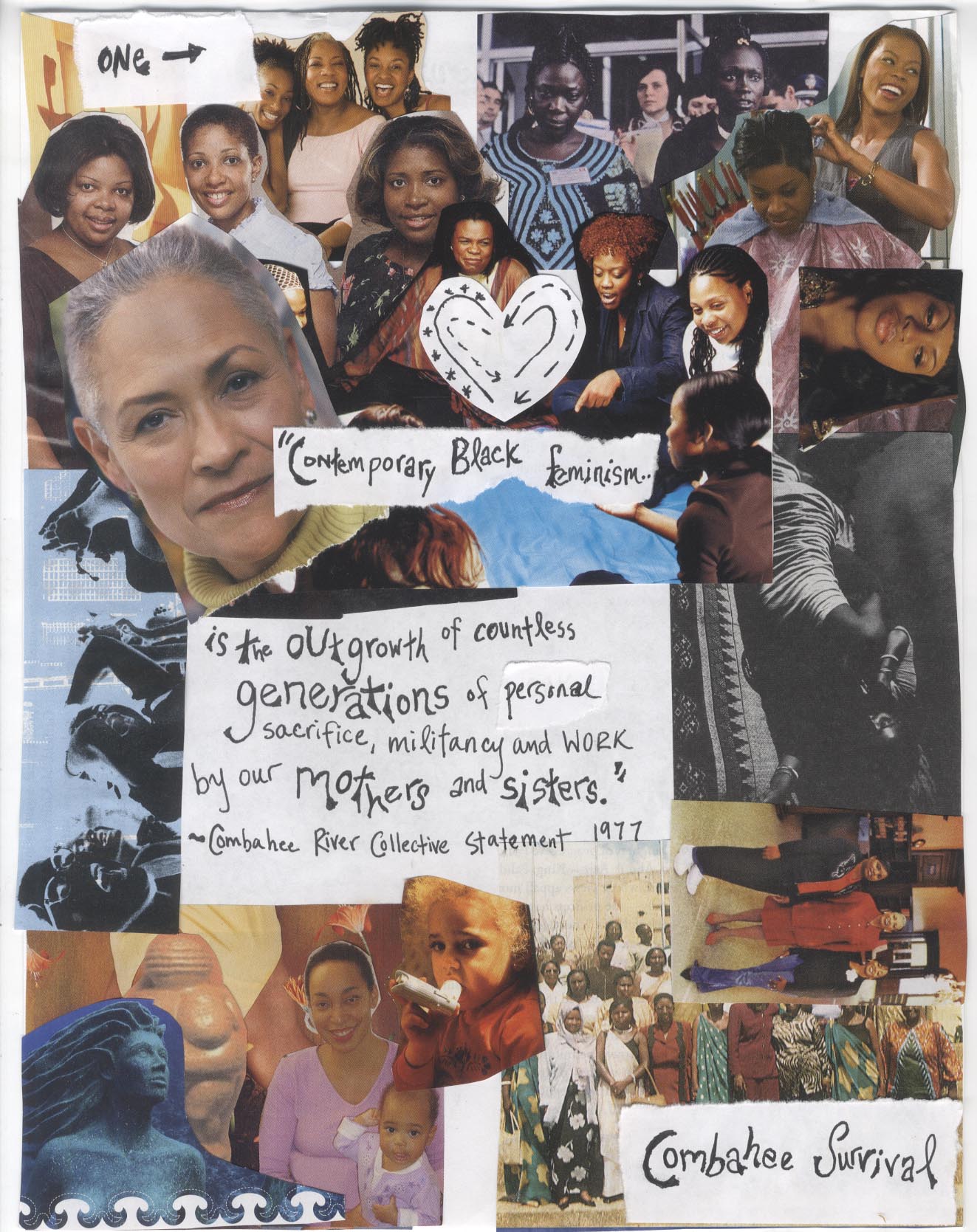
Check out the Combahee Survival Project at www.combaheesurvival.wordpress.com!
We were never meant to survive. None of us. We were never meant to find each other, love each other, remember the warriors that came before. We were never meant to know these histories. We were never meant to turn our trauma into a map for transformation. We were never meant to survive. But we do it anyway. Break it down. Sur viv al. Life underneath waiting to embrace all of us. Survival is a poem written in a corner, found waiting in a basement, forgotten. Survival is when the timeliness of your word is more important than the longevity of one body. Survival is spirit connected through and past physical containers. Survival is running for your life and then running for Albany city council without consenting to the State. Survival is shaping change while change shapes you. Survival means refusing to believe the obvious. Survival means remembering the illegal insights censored in the mouths of our mothers. Survival is quilt patterns, garden beds. Survival means growing, learning, working it out. Survival is a formerly enslaved black woman planning and leading a battle that freed 750 slaves from inside an institution called the United States Military. Survival is out black lesbians creating a publishing movement despite an interlocking system of silences. Survival is a group of black women recording their own voices, remembering a river, a battle, a warrior and creating a statement to unlock the world. Survival is like that. We were never meant to survive. And we can do even more. This booklet moves survival to revival, like grounded growth, where seeds seek sun remembering how the people could fly. We are invoking the Combahee River Collective Statement and asking how it lives in our movement now. And the our and the we are key to this as individual gains mean nothing if others suffer. We were never meant to survive but we will thrive. We want roundness and wholeness, where everyone eats and has time to be creative has time to just be, What tools does it give that are necessary to our survival? What gaps does it leave us to lean into? Black feminism lives, but the last of the originally organized black feminist organizations in the United States were defunct by 1981. Here we offer and practice a model of survival that is spiritual and impossible and miraculous and everywhere, sometimes pronounced revival. Like it says on the yellow button that came included in the Kitchen Table Press pamphlet version of The Combahee River Collective Statement in 1986 "Black Feminism LIVES!" And therefore all those who were never meant to survive blaze open into a badass future anyway. Meaning something unpredictable and whole. We were. Never meant. To Survive. And here we are. And beyond survival, what of that? In 1977 the Combahee River Collective wrote "As Black women we see Black Feminism as the logical political movement to combat the manifold and simultaneuos oppressions that all women of color face." They also said "The inclusiveness of our politics makes us concerned with any situation that impinges on the lives of women, Third World and working people." And they concluded: "If Black women were free, it would mean that everyone else would have to be free since our freedom would necessitate the destruction of all the systems of oppression." Today we, a sisterhood of young black feminists, mentored in words and deeds by ancestors, elders, peers and babies, assert that by meditating on the survival and transformation of black feminism we can produce insight, strategy and vision for a holistic movement that includes ALL of us. So while this is a project instigated by self-proclaimed (and reclaimed) black feminists, our intention is that it can be shared and changed by everyone who is interested in freedom.
Special note to firewalkers...how great would it be to teach with, study groups and work with this amazing document? Let's do it!
www.brokenbeautiful.wordpress.com
Saturday, October 04, 2008
Subscribe to:
Posts (Atom)